
Selection Committee Chair Mari Suzuki
Vice President / Executive Secretary, Asian Community Center 21
Outline of Fiscal 2026 International Grant Program “Cultivating Empathy Through Learning from Our Neighbors: Practitioners’ Exchange on Common Issues in Asia”
As in the previous fiscal year, the theme of the Fiscal 2026 International Grant Program was Cultivating Empathy Through Learning from Our Neighbors: Practitioners’ Exchange on Common Issues in Asia.
The goal of this program is to provide grants for projects in diverse fields that address common issues faced by two or more countries or regions in East Asia, including Japan, Southeast Asia, and South Asia (which has been within the scope of the grants since fiscal 2022).
It is hoped that the members of each project team will think, act, and create something new together as colleagues addressing the same issue, and further, that each project will develop into a partnership leading to the change of society through a bidirectional learning process, while also fulfilling the requirements regarding transnationality (the participation of members from multiple countries on equal footing), a cross-sectoral approach (the creation of a team and collaborations involving different sectors), mutual learning (learning from each other and sharing experiences through direct interactions), and foresight (acquiring new perspectives that will lead to developments in the future).
The achievements expected via the project activities are: (1) Identification of issues and review of the current status of the issues, (2) activities leading to solutions to the issues, and (3) the creation and delivery of tangible output such as recommendations, works, and other deliverables.
The period for submitting proposals to the fiscal 2026 grant program was two months from April 1 to May 31, 2026.
As in the previous fiscal year, the countries within the scope of the program were the countries in East Asia (including Japan), Southeast Asia, and South Asia (which has been within the scope of the grants since fiscal 2022). The amount to be granted was a maximum of 5 million yen per project for a one-year grant period and up to 10 million yen per project for a two-year grant period. The planned total amount of the grants was 80 million yen.
We have accepted applications for administrative expenses whose amounts do not exceed 10% of the total budget of the project, starting with the fiscal 2025 grant program.
Outline of Solicitation of Proposals and Pre-application Registrations and the Number of Applications in Fiscal 2026
- A total of two online briefings were held in April 2026. Approx. 210 people participated in them (an increase of 40 people from the previous fiscal year). We also disseminated information via a mailing list, social media, and other means to ensure that this grant program is widely known.
- During the application period, the secretariat consulted with potential applicants prior to their submissions of a proposal 131 times (up approx. 30% from the previous fiscal year). These consultations were conducted by email, online, or face-to-face based on the concept notes (the outline of the proposal) created by the potential applicants.
- There were more than 1,100 pre-application registrations, approx. 500 more than in fiscal 2025 and exceeding the 1,053 received in fiscal 2024, when access from South Asia (which has been within the scope of the grants since fiscal 2022) increased.
- The number of applications increased by 208 (up approx. 86%) compared to the previous fiscal year, reaching 446 (equivalent to approx. 40% of the pre-application registrations). The number of applications increased by approx. 46% compared to fiscal 2018 (242 applications), significantly exceeding the pre-COVID-19 pandemic level.
| 2024 | 2025 | 2026 | |
| Number of pre-application registrations | 1053 | 599 | More than 1,100 |
| Number of applications (percentage of pre-application registrations) | 189 (17%) | 238 (40%) | 446 (40%) |
Outline of Applications (446 applications in total)
- This fiscal year, 402 applications were from people who had never previously received a grant from the Toyota Foundation.* This was 90% of the total applications received. This suggests that this program was widely publicized, as was done in the previous fiscal year (88%, 209 applications).
- There are two project grant periods, one year and two years. 73 projects (16%) applied for a one-year grant, while 373 (84%) applied for a two-year grant.
- Applicants are free to specify any information they choose to in the target field in their proposal. The application form does not require them to select categories to choose from. Therefore, it is difficult to categorize the applicant projects clearly, but they are roughly classified as follows.
1. The environment, climate change, a recycling-oriented society, and energy
2. Education, human resource development, and AI learning
3. Medical care, public hygiene, healthcare, and mental health
4. Disaster control, disaster risk reduction, and disaster resilience
5. Human rights, gender, diversity, social inclusion, and welfare
6. Regional revitalization, community development, urban development, and tourism
7. Culture, art, multicultural co-existence, and international exchange
8. International cooperation
9. Welfare and nursing care for the aged and super-aging society
10. Agriculture, food security, and agri-food
11. AI, advanced technologies, and digital governance
12. Peacebuilding and peace education
13. Labor
14. Governance
- Nationality of the representative: One of the requirements of this program is that the main place of residence of the representative of the applicant organization is Japan. The most common nationalities among the project representatives were Japanese (250 applications, 56% of applications) and Indonesian (88 applications, 19.7%). These two countries constituted approx. 76% of the total, followed by Malaysia and India (11 applications each), South Korea, Mongolia, and the United States (8 each), and China, the Philippines, and Vietnam (6 each), and others. By region, 275 applications were from East Asia (62%), 121 were from Southeast Asia (27%), 24 were from South Asia (5%), and 26 were from other regions (6%). The percentage of applications from Southeast Asia increased from the previous fiscal year (21%).
- It is required that countries within the scope of the program include at least two countries or regions in East Asia including Japan, Southeast Asia, and South Asia. When this requirement has been fulfilled, countries in other regions may also be included for reference. There were more than 30 countries within the scopes of all 446 applicant projects in fiscal 2026, and the majority of the projects included two or three countries each within their scope. Japan was the most common of the countries within the scope of the program (338 projects), followed by Indonesia (241), Malaysia (106), Thailand (74), the Philippines (62), Vietnam (50), India (47), South Korea (43), Taiwan (38), Bangladesh (32), Nepal (32), Cambodia (26), China (25), Singapore (24), Mongolia (19), Sri Lanka (15), Pakistan (11), and others.
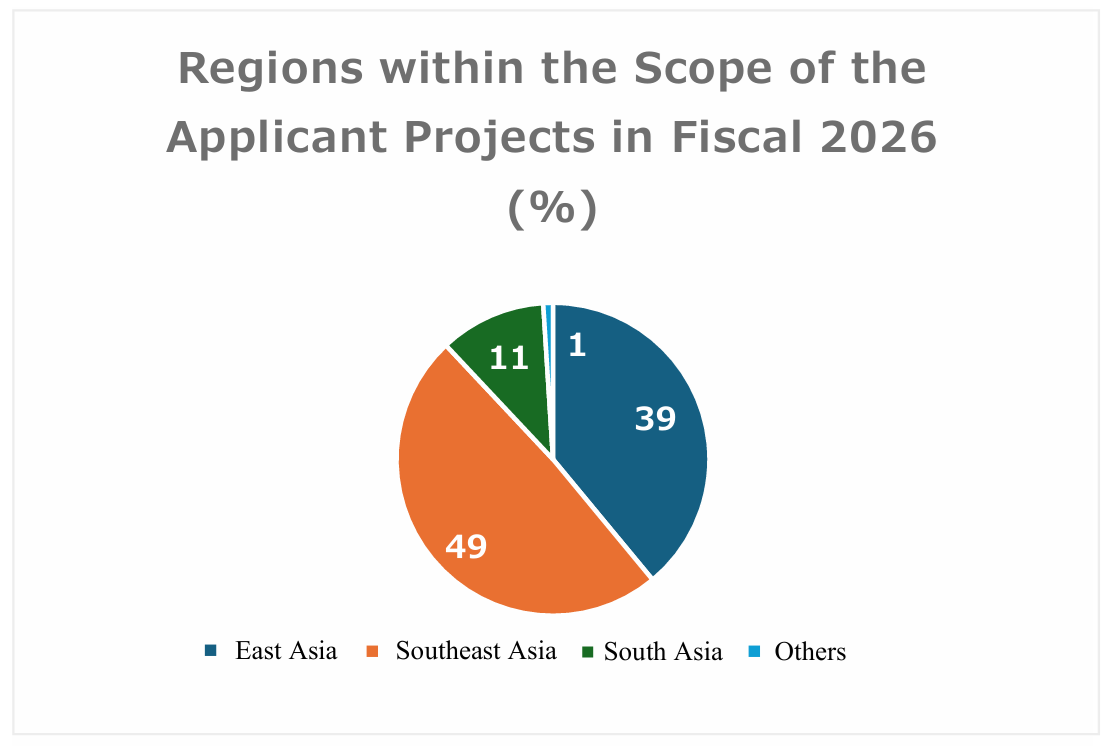
By region within the scope of the program, Southeast Asia was most common (49% of projects), followed by East Asia (39%), South Asia (11%), and other regions (1%).
*Includes representatives and leading members of all the projects that have ever received grants under any Toyota Foundation program in the past.
Selection Process and Results
Program officers from the secretariat reviewed all the 446 applications submitted this fiscal year, sorted them out based on whether the applications were incomplete, whether they met the prerequisites and other criteria, and then requested that the selection committee members evaluate the applications.
This program has a four-member selection committee, and one of its members was newly appointed. First, each member read the applications carefully, selected projects they recommend, and commented on the proposals, including their thoughts on proposals, questions for each applicant, and their evaluations of the proposals, before the secretariat collected the information about the recommended projects. Each committee member carefully examined the applicants' answers to questions, which were obtained at a later date, and described their reasons for their evaluations of the projects, including the projects they did not recommend.
The number of applications received this fiscal year was among the largest in recent years, and this made the program highly competitive. In each application, the project planner or group expressed their desire to create a better future by learning from other people, deepening interactions, acknowledging and respecting each other's differences while addressing a broad range of problems, including global issues such as the increasing seriousness of climate change, the frequent occurrence of major disasters, and the rapid expansion of AI. We would like to express our respect for the people who submitted their applications and took the time to prepare them with their team members from different countries.
Outline of Selected Projects (Nine Projects)
Through the above selection process, nine projects were selected in fiscal 2026 (total amount of the grants: 80,000,000 yen).
- Number of projects and project period: nine projects, two years (all projects)
- Countries (at least two countries per project): Japan (4 projects), South Korea (3), Indonesia (3), the Philippines (3), Taiwan (2), Thailand (2), Vietnam (2), Bangladesh (2), and East Timor and Sri Lanka (1 each)
- Major fields covered by the projects: the environment, climate change, education, mental health, welfare for the aged, disaster control and disaster risk reduction, and peacebuilding
- Problems and issues addressed by projects: responses to climate change and natural disasters, suicide of children and young people, promotion of children's rights and diversity, dementia, and AI education
For reference, selection committee members provided the following feedback and comments about the projects that were submitted this fiscal year and under the grant program.
- While there are many projects with clearly defined objectives, there is significant room to enhance their quality and outcomes—even without radically altering the structural framework—by focusing on the importance of appropriately involving and valuing the necessary stakeholders, rather than merely exchanging ideas.
- While it may be difficult for people to achieve results by executing initiatives only during the grant period, it is necessary to think in an organized manner about the opportunities that will be created and connected to subsequent interactions or developments through this grant program.
- It is possible to see not only the people who are directly affected and those placed in the most difficult situations but also people who are providing support and are committed to issues can be regarded as people involved in projects. To solve major problems, it is important to plan carefully who you will engage with, what changes you want to create, and the areas that you will focus on to achieve broad changes. It is important to have a perspective that helps you determine which elements of an overall structure have a significant influence.
- A major feature of this grant program is that it facilitates mutual learning by different countries, but it is very difficult to effectively do this. Mutual learning beyond the boundaries between countries is very meaningful, but some initiatives seem to have added countries just to increase the number of countries involved due to a preoccupation with fulfilling requirements for form's sake. The reasons why mutual learning is necessary and the value that will be created should be considered when designing a project.
- I think that it is not necessarily a requirement that all these initiatives be successful. If something did not go well, it should be carefully reviewed, and the reasons why it didn't go well should be discussed and processes and results should be recorded. I think this will enhance the value of not only the achievements from individual projects but also the project as a whole.
- If it is believed that it is important to solve a social issue, inevitably, a highly professional group will play a central role in solving the issue. In highly professional fields, however, discussions tend to be extensions of existing knowledge or activities. I therefore think it is important to clarify the possibilities for new mutual learning projects. In contrast, finding a direct solution to an issue is not the main objective of projects that work to increase participants' understanding of or increase their awareness of problems by involving intermediate support organizations or mediators in the projects. These projects tend to emphasize the value of mutual learning and interactions. It was difficult for me to apply consistent criteria regarding the points that would be emphasized in the selection of projects considering the backgrounds of the planners and participants for the submitted applications.
Introducing Adopted Projects
To conclude, two of this fiscal year's nine selected projects are introduced below.
| Representative: Tomoya Hirota |
| Title: Japan-Korea Collaborative Project for Youth Wellbeing: Co-creating Practical Guidelines for Suicide Prevention Integrating a Youth Culture Perspective |
| Countries: Japan and South Korea |
| Term: 2 years |
| Amount: 9,500,000 yen |
Project overview
This project aims to enhance the well-being of children and youth by establishing a collaborative framework between Japan and South Korea to address the critical issue of youth suicide. Bringing together experts from medicine, education, government, civil society, cultural practices, and peer support groups, the initiative focuses on emerging, unprecedented challenges in highly digitalized societies, such as the spread of high-risk behaviors on social media and the increasingly obscured nature of digital youth culture, which conventional frameworks fail to adequately address.
Through regular online meetings and reciprocal site visits, the project will conduct an iterative and comparative review of advanced practices in both nations. The Japanese team will learn from South Korea's school-based prevention education, mental health research, and cultural/artistic approaches to youth care. Conversely, the South Korean team will gain insights from Japan’s search-linked digital outreach and peer support networks addressing over-the-counter drug overdose issues.
Ultimately, this project will co-create and disseminate a joint policy proposal and practical guidelines for suicide prevention that integrate youth culture perspectives tailored to the digital environment, laying the foundation for an international collaborative model adaptable across other Asian countries
Members of the selection committee stated that it was not clear how young people themselves would participate in the project, but it was selected because it was highly evaluated for seeing the problem of suicide as a complex issue involving not only medical care and education but also institutions, culture, digital spaces, and the experiences of people who have suffered because of the issue, and for it adding new members to its team while leveraging an existing network.
| Representative: Yuta Tonegawa |
| Title: Project AILIC: AI Literacy through International Co-development |
| Countries: Thailand, Indonesia and Bangladesh |
| Term: 2 years |
| Amount: 9,500,000 yen |
Project overview
Generative AI is creating new opportunities for learning and work, but there is also a growing divide between those who can use AI productively and those who cannot. In many developing countries,education systems are struggling to respond to rising demand for AI-related skills whileaddressing challenges such as misinformation, online scams, and cybersecurity risks.
Project AILIC brings together educators and stakeholders from Thailand, Indonesia, andBangladesh to co-develop a practical and adaptable AI literacy model for resource-constrainedsecondary schools. Through online mutual learning, cross-country school visits, and collaborativereflection, participants will identify effective classroom approaches, implementation barriers, andlocally relevant solutions.
The project aims to directly engage with more than 300 students and 30 educators across the threecountries. It will co-develop a practical AI literacy model that can be adapted to resource constrained contexts and document the resulting lessons and recommendations. The model and itsfindings will be disseminated through a project report, academic publications, and a documentaryfilm, as well as through ICSEC and APCSE networks. Through these efforts, the project aims tocontribute to educational practices, policy dialogue, and regional collaboration on AI literacyeducation across Asia
The project was selected in recognition of its established networks in each participating country and its identification of target schools, which provide a strong basis for achieving concrete outcomes. The committee also valued the team’s range of expertise and its potential to develop guidelines that can be widely referenced. At the same time, the committee requested that project initiators fully consider cultural and social factors and the impact of social class before starting the project because countries in different situations will be compared, and that they evaluate the project activities and record them meticulously.